
Written by: Margaret Devlin
Once, a professor scribbled in the margins of my paper that it seemed like I had an obsession with food. Four weeks into the semester and I had already written poems on scrambled eggs, pesto, coffee creamer, and Thanksgiving dinner.
These poems were about more than meals, of course; they were about heartache, grief, anxiety. But they were also about food. Food plays a unique role in our lives, as well as in our literature. We have to eat. Who do we eat with? What do we eat? What does it mean?
Thomas C. Foster wrote a guidebook titled, How to Read Literature Like a Professor, which gives context to some common literary symbols. The second chapter, “Nice to Eat with You: Acts of Communion,” describes how dining scenes are notoriously difficult to write, “and so inherently uninteresting, that there really needs to be some compelling reason to include one in the story.”
Foster posits that a meal highlights how characters are building or harming their relationships. “Come on,” he writes, “food is food. What can you say about fried chicken that you haven’t already heard?”
The acts of cooking, eating, and feeding others stimulate our senses and bring us together, without a doubt. One of my favorite scenes from Hayao Miyazaki’s Ponyo takes place over a warm meal. Having dried off after a rainstorm, the characters sit and enjoy steaming bowls of ramen. The scene is more than heartwarming. There’s a deeper sense that the characters have reached safety, that they are finally in good hands.
In her witty (if not neurotic) novel, I Feel Bad About My Neck, Nora Ephron takes an entire chapter to recount her relationship history through cookbooks. It’s brilliant. She describes the competitive nature among her friends surrounding the dishes they made, explaining, “We were looking for applause, we were constantly performing, we were desperate to be all things to all people.”
When Ephron entered her first marriage, she recalls how she simultaneously “entered into a series of absolutely insane culinary episodes,” where she made “the Brazilian national dish…wrapped things in phyllo… stuffed grape leaves.”
As Ephron aged, divorced, married again, divorced again, her style of cooking changed. She turned to simple, satisfying meals—an emblem of her growing self-assurance.
Returning to Foster, I want to mention an anecdote he cites of Sigmund Freud, who supposedly once stated that, “sometimes a cigar is just a cigar.” Sometimes food is just food.
Adrienne LaFrance wrote a piece for The Atlantic listing some of her favorite, unforgettable descriptions of food in literature. “Even in the hands of the greats,” LaFrance says, “food scenes can seem less than central to a story, more filler or filigree than substance.”
LaFrance points to twelve scenes that do more. The meals are mesmerizing and enticing. She includes an excerpt from Sendak’s Nutshell Library, titled “Chicken Soup with Rice.” The small words, meant for children, exemplify what food does best. Food helps us to find what is extraordinary within simplicity. I’ll close with an excerpt from “Chicken Soup With Rice: A Book of Months,” by Maurice Sendak.
In September
for a while
I will ride
a crocodile
down the
chicken soupy Nile.
Paddle once
paddle twice
paddle chicken soup
with rice.
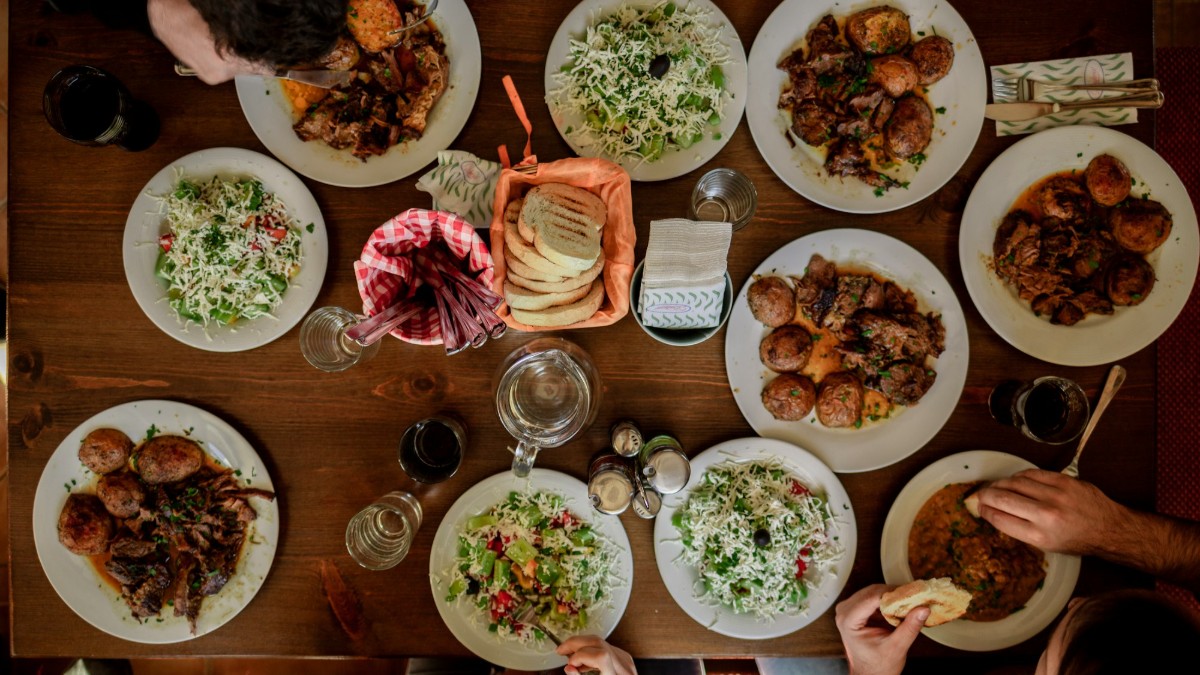
Featured Image Caption: Enjoying a meal together, but is it more than a meal?
