
Written by: Zoe Yoo
If you said to me ten years ago that I’d be diagnosed with ADHD, I would’ve told you, “Yeah, that makes sense.” At the ripe old age of 20, I finally got the professional confirmation that my friends, family, and I knew all along — that I had Attention-Deficit/Hyperactivity Disorder.
You’ve probably heard the term “ADHD” thrown around a lot, but most people don’t know what it actually is. I would give you the official DSM-5 definition, but it is way too long for this post, so instead I’ll link it here for your own perusal. In short, it’s one of the most common neurodevelopmental disorders in which children “may have trouble paying attention, controlling impulsive behaviors, or be overly active” (About ADHD). Of course, there’s so much more that goes into having ADHD, with symptoms including: talking too much and too fast, daydreaming, fidgeting, and more (Symptoms of ADHD). It’s important to note that a neurotypical person may exhibit symptomatic behaviors, but there’s a difference between normal distraction or restlessness and ADHD. So, as a disclaimer: Please don’t read this post and diagnose yourself! Speak to a professional!
As stated in the definition, ADHD is a neurodevelopmental disorder in children. However, it took me until I was 20 to actually get the diagnosis. This was because, for a long time, I got unintentionally exceptional at masking (hiding) my ADHD symptoms with something called General Anxiety Disorder (GAD). Contrary to its name, GAD is different from the very normal anxiety people experience when they’ve got a lot of deadlines or are going through big life changes. I can’t speak for everyone, but for me it was having a panic attack every single day (and this is not an exaggeration) about anything from going to bed an hour later than normal, getting less than an A on a test, ruminating over whether the fact that someone looked at me a second too long meant they hated me, and so much more.
For so long, my anxiety disorder “countered” my ADHD. For example, my anxiety fought the urges to be impulsive because I was too worried about what people thought of me. The same goes for potentially missing a deadline, assignment, or detail that the disorganization of ADHD was accounted for with a thousand reminders, spreadsheets, and calendars. It wasn’t until more recently, when I finally got better at managing my anxiety (with the help of therapy and medication!), that the ADHD symptoms became more noticeable. As anxiety loosened its reins over me, ADHD finally got a chance to take over.
Both of my younger brothers have ADHD, so I knew what the symptoms were and what to look out for. In fact, ADHD is incredibly genetic, and when your siblings have it, you’re nine times more likely to develop it yourself (ADHD Causes). I always suspected I had it, just from noticing similarities between my brothers and me, but it wasn’t until last semester that it got to the point where I needed confirmation.
During finals season last semester, I had eleven papers to write — ELEVEN. Now, don’t get me wrong, this is a lot for anyone. But I started preparing for finals during spring break and still ended up with eleven papers come finals week. Every day during the break, I would sit down at my local Panera Bread and attempt to finish some of the papers I knew I would have because I knew it would be hell to do it all during finals week. But every day, no matter how hard I tried, I could not get anything done. I could never focus and would come home each day and have a panic attack because of how disappointed I was in myself. The anticipation of having to do it all during finals week nearly killed me. I found out later that it was during this time that my mom started compiling her observations in preparation for a potential diagnosis.
My anxiety made it so there would be no universe in which I didn’t get my work done, but my ADHD made it as difficult as possible along the way. During finals week, I couldn’t focus or sit still, despite doing everything in my power to lock in. I tried working in different environments, completely uninstalled all social media, put my phone in another room, etc., and yet it would take me HOURS to write even a single sentence. Again, this is not an exaggeration.
Thankfully, with the help of my anxiety-driven need for academic excellence and perfection (I say sarcastically), all of my work got done in time. But it was probably one of the worst experiences of my life. It was at this point that I knew I needed to get officially diagnosed. After getting the diagnosis, I texted my friends and was met with sincere congratulations. Most people associate diagnoses with being negative, but I’m here to tell you that they’re not always a bad thing. I’ll break down what I gained from this diagnosis into three things: validation, understanding, and community.
1. Getting that diagnosis validated my struggles.
It was confirmation that I’m not just lazy or undisciplined. I did everything in my power to focus, but it was beyond my control. It was permission to stop comparing and holding myself to the neurotypical standard of others. I can give myself some grace and accept the way my brain works.
2. Getting that diagnosis helps me understand myself better.
I get to brainstorm with my therapist new coping strategies and skills to figure out what different things I need to do so I can study, learn, or even sleep better. It was like I finally found a missing piece to the puzzle. Habits that I used to write off as little quirks or personality traits suddenly made sense. Oh, that’s why I can’t watch a movie or show without snacking or multitasking! Oh, that’s why I always sleep, sit, and study in weird positions! Oh, and that’s why I yap, nap, and hyperfixate!
3. Getting that diagnosis gave me a community.
I know that I’m not alone in my experiences and struggles, and have gained a whole new group of people who know what I’m going through. I had the pleasure of attending the AWP Conference a few weeks ago, and I was so amazed by how many panels there were on neurodivergence, specifically ADHD. I got to listen to everyone share tips, laugh about our experiences, validate each other’s struggles, and learn about positive aspects of having ADHD.
If there’s anything to take away from this post, it’s that having ADHD and/or other mental health/neurological disorders is not something to be ashamed of. It may seem scary at first to have this new label put on you, but it’s not at all something to be stigmatized or looked down upon. Yes, it causes a lot of struggle, but remember, we’re working a hundred times harder in a world that caters to the neurotypical. I hope that my openness about my journey helps to continue the conversation and normalize mental health.
Works Cited
“About ADHD | Attention-Deficit / Hyperactivity Disorder (ADHD).” CDC, 25 November 2025, https://www.cdc.gov/adhd/about/index.html. Accessed 24 March 2026.
“ADHD Causes: Is ADHD Genetic?” ADDA, 25 October 2022, https://add.org/is-adhd-genetic/. Accessed 24 March 2026.
“Symptoms of ADHD | Attention-Deficit / Hyperactivity Disorder (ADHD).” CDC, 16 May 2024, https://www.cdc.gov/adhd/signs-symptoms/index.html. Accessed 24 March 2026.
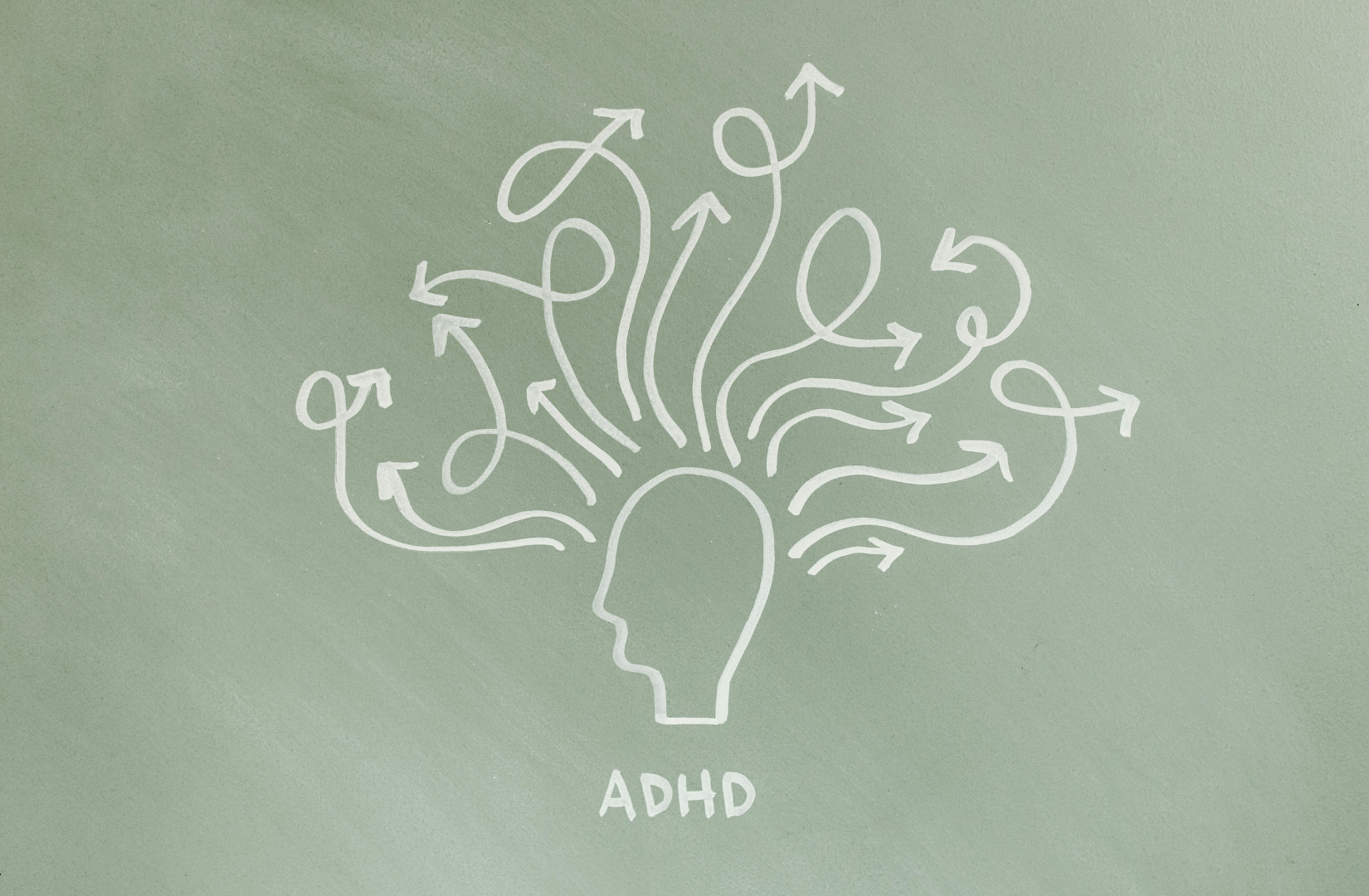
Featured Image Caption: Outlined drawing of a head with many arrows coming out from it, captioned with “ADHD.”
