
Written by: Aidan Srb
I recently decided to revisit Badlands (1973), the first film in the career of legendary American filmmaker Terrence Malick. What at first appears to be Malick’s most straightforward film, at least in terms of narrative, turns out to be as strange and unwieldy as anything he’d make after, almost totally consumed by the wandering lyricism that would come to define his later works. More interesting, however, is what the film seems to be saying about the violent character at its center.
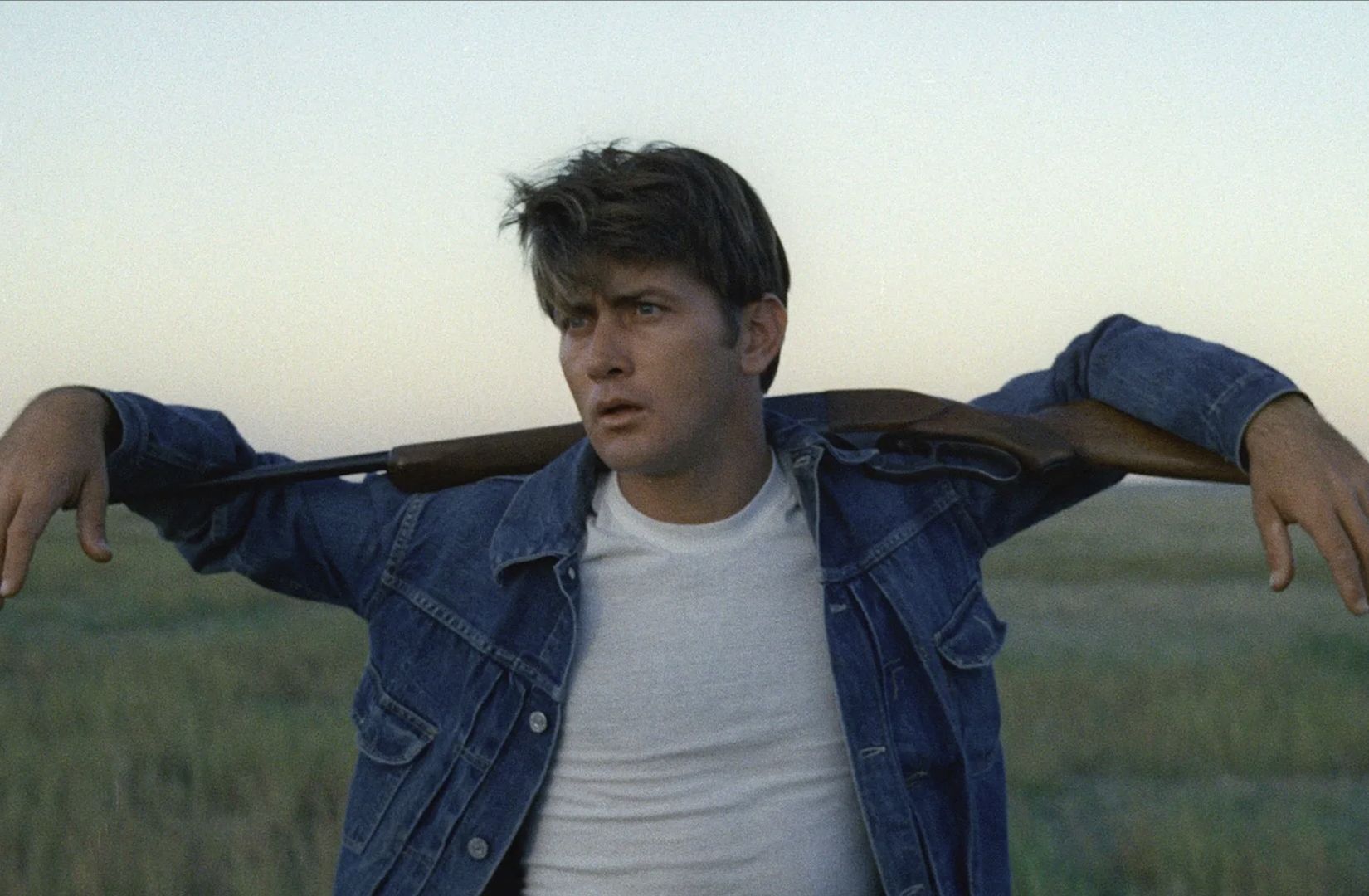
Badlands tells the story of a pair of young lovers who commit a series of apparently circumstantial murders while on the run from the law. But the situation is even stranger than it first appears: for one thing, Holly (Sissy Spacek) is a 15-year-old girl who doesn’t actually kill anyone, merely watching as the 25-year-old Kit (Martin Sheen) does all the shooting. This clearly predatory dynamic is further complicated by the fact that Holly’s protective but emotionally abusive father is the first victim of Kit’s killing spree, his death largely the result of his desire to keep his teenage daughter away from Kit. Holly has the opportunity to call the police on Kit and report the murder of her father, but she doesn’t; Kit burns down the house, and the two of them drive off together into the night.
Further killings ensue, none of them really premeditated, all justified by Kit as necessary to avoid getting caught. They don’t seek out victims and, in fact, spare the lives of several people they encounter. What quickly becomes clear is that Kit didn’t start out with any real plan for the future, and he never really comes up with one that makes any sense. He often seems more in love with himself than with Holly, which makes his initial decision to kill her father all the more perplexing. It might as well have resulted from sheer boredom, from a desire to violently shake up his world, which had previously involved working as a garbage collector. Whatever he found in his initial relationship with Holly, he wanted to cling onto it so desperately that he was willing to kill to keep her with him.
Ultimately, we don’t actually know much about Kit beyond the surface because the film is only superficially about him; the voiceover narration supplementing the story is delivered by Holly, and the film is therefore filtered through her perspective. Her narration is retrospective and, naturally, colored by bias and unreliability. This is where the film becomes interesting: we see Kit through her (naïve) eyes, the way she wants him to be seen, which involves a rather romanticized view of their early days together. This is why he appears seemingly out of nowhere at the beginning of the film, with no background, no parents, and no family, as though he isn’t bound to this world and has no history beyond this narrative. This makes him a malleable object to be shaped by Holly and her audience — which is an ironic reversal, in a way, as it is she who begins the story as the unformed object of innocence for Kit to mold into his ideal girlfriend/partner-in-crime. This subtle shift in power dynamics is fascinating because it positions true power as belonging to the storyteller, the one with the ability to shape their own narrative, the one who, we might say, gets the final word in.
This aspect of the film becomes clearer as it goes on. At the point where Holly prepares to drop out of Kit’s story, she begins to rely more on speculation in her narration, rather than delivering a clear account of what happened. Just before we see Kit’s outraged reaction to Holly’s decision to turn herself in, she mentions his fear of being shot down alone with no one to scream out his name. We don’t see Kit say this himself, so we can only take Holly’s word for it, calling into question whether she is creating a character or recreating a real person. This isn’t the only instance of Holly speaking for Kit in this manner, but it is a drastic moment of characterization before Kit’s inevitable fall. Then, in the sequence during which Kit is finally caught by the police, Holly tells us that she doesn’t believe the official narrative that Kit got a flat tire — instead, she thinks he merely gave up running and turned himself in. As she says this, the film indeed shows us Kit shooting out one of his tires with a gun and turning himself in; the question is, are we watching what really happened, or what Holly thinks happened?
By the end of the film, we become aware that we have just witnessed the creation of a legend. Kit is mythologized by the simple fact that someone else, someone who doesn’t necessarily have all the facts, is telling his story, and we are seeing him through their eyes. At the end of the film, Holly’s narration confirms that Kit was executed for his crimes, which means she has created this image of Kit for us after his death. Kit has no interiority within the film’s form; we see him mostly through the eyes of others, an image meant to replicate the original — but not the original itself.
The film’s most interesting meditation on this idea comes in the form of what at first appears to be a throwaway line, until the line shows up a second time later on. When first describing Kit, Holly tells us in her narration that he looks like the actor James Dean. This observation comes up again when one of the police officers who arrests Kit makes the same comparison to James Dean, which elicits Kit’s biggest smile of the film. James Dean, quite famously, died young, in his mid-20s. This essentially immortalized his youthful appearance in pop culture, as he never got the chance to age out of it. He became an aesthetic object — a tragic one, but an object nonetheless, one that cannot speak for itself but only accept whatever is projected onto it. That is why Kit smiles at the comparison and why he willingly accepts what he is to become: a legend, a myth, seen only through the eyes of others, effectively immortal.
Just before he gets caught, Kit shifts his rearview mirror away from the pursuing police car so that he can fix his hair, like an actor preparing for a scene. Naturally, he wants to control his own legend, which includes choosing his own ending. But he cares deeply about how he is perceived because he understands that his story will be told by others — that is the only way to ensure that the narrative doesn’t die with him. So he makes sure to look his best for the police officers who catch him, because first impressions matter: after all, these are the people who will tell the world about who he was…and what he did.
Featured Image Caption: Martin Sheen as Kit in Terrence Malick’s Badlands.
