
Written by: Zoe Yoo
You had to have been living under a rock for the past decade if you haven’t heard of Stranger Things, the supernatural Netflix show that flipped the world Upside Down. Throughout its nearly ten-year runtime, the show has garnered hundreds of thousands of fans dedicated to the story, its characters, and their relationships. Two of the fandom’s most popular “ships” are between three of the show’s main characters — Will Byers, Mike Wheeler, and Eleven — with ship names known as Byler (Will and Mike) and Mileven (Mike and Eleven), respectively. This unconventional love triangle dominated the internet as fans fought over who they loved more: Mike and Will or Mike and Eleven. Until the show’s infamous season finale, fans from both sides of the shipping war genuinely had no idea which relationship would come out on top. So, when the series ended with Prince’s “Purple Rain” playing over Mike and Eleven’s controversial goodbye kiss, many were left in heartbroken shock over the supposed winner of the decade-long love triangle.
You may be wondering, why did people genuinely believe Byler had a chance at breaking the historic curse of non-canon LGBTQ+ ships? Well, it’s because Stranger Things creators, showrunners, writers, cast members, and Netflix themselves deceivingly led them on in an exploitative marketing and creative tactic known as queerbaiting.
Queerbaiting is most commonly defined as: “a term used to describe certain creative and marketing practices that seemingly hint at, but do not depict same-sex romance or other LGBTQ+ representation . . . these practices are intended to attract a queer or straight ally audience with the suggestion or possibility of queer relationships and/or queer characters, while not alienating homophobic members of the audience.” Based on this definition, I will summarize the major arguments for why many believe the show is guilty of this offense.
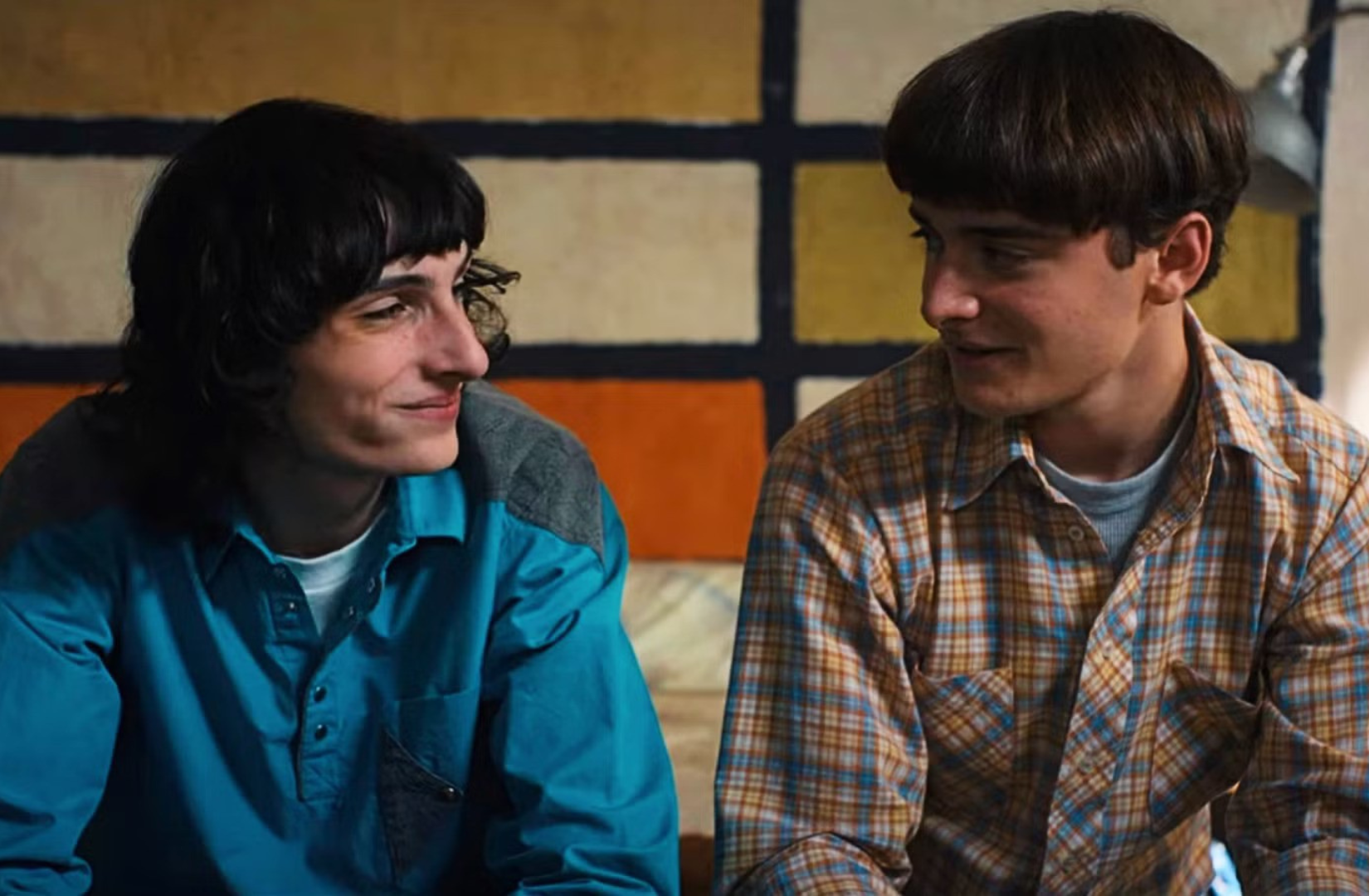
Throughout the series, a romantic relationship between Will and Mike had been hinted at. From the show’s opening minutes, Will and Mike were seen having a very close bond. For instance, when Will went missing, Mike was the one most adamant about finding him. In season two, when Will was being bullied, Mike was the most protective of him. Their relationship gets tested in season three when Mike starts spending more time with his girlfriend, Eleven, and Will gets upset about the lack of time they’re spending together. With a rainstorm as their backdrop, Mike attempts to justify his actions by yelling, “It’s not my fault you don’t like girls!” one of the show’s more direct references to LGBTQ+ themes.

In season four, Mike and Eleven are drifting apart, Eleven getting mad that Mike never says he loves her. Seeing this, Will attempts to reassure his “friend” by gifting him a painting he pretends is from Eleven, coupled with an impassioned speech in which he applauds Mike for never making the super-powered Eleven feel like a mistake. And while Mike is too oblivious to understand the queer undertones of the conversation, viewers are made to realize that Will is also talking about himself. The scene closes with Will smothering his sobs so Mike doesn’t notice.

Will comes to terms with his feelings for Mike in season five and seeks help from Robin, one of the only other LGBTQ+ characters on the show, on how to flirt with him. Later, when Mike is about to be killed, the audience sees Will unlock his own superpowers. Through a tear-jerking montage of Will and Mike’s childhood, Will finally accepts himself for who he is despite the homophobic time period. With all of this, including many more scenes, color symbolism, set and costume design, very deliberate musical choices, and cast members, showrunners, and writers playing into the possibility of a romantic relationship, it makes perfect sense that so many would root for and identify with the journey these two characters go on.

Stranger Things’ Byler hints were so tremendous that when the show chickened out of explicitly portraying the relationship, a large portion of fans genuinely believed the show’s ending was faked and that a secret last episode would later debut. Instead of empowering the LGBTQ+ community, which strongly identified with the ship and their story, the Duffer Brothers (Ross and Matt Duffer, showrunners and creators) decided to laugh in their faces with a poorly handled, grossly uncomfortable coming-out scene and an absolutely diabolical “rejection” scene. After Will comes out to an entire crowd of mostly irrelevant people, Mike finally realizes that Will has had feelings for him this whole time. Afterwards, Will asks Mike if they could still be friends. Mike answers with, “Friends, no thanks,” [insert dramatic pause from Mike and then a cut to a hopeful look on Will’s face] “Best friends.” Whether or not the Duffer Brothers were rivaling Mike’s own obliviousness with this incredibly tone deaf scene, it came off as a one last point-and-laugh of all those who identified with Mike and Will’s story.

It strikes me as particularly manipulative that Netflix, the Duffer Brothers, writers, and the actors played into the ship for so long. They gave people actual hope that there was a chance of the relationship happening by doing things such as: reposting, replying to, and making their own Byler posts, carrying signs during the 2023 WGA Strike that said “Byler won’t write itself,” telling fans to “definitely ship [Byler],” saying that fans will be very “satisfied” with Byler’s ending, and so much more. Additionally, why did they wait until after the show ended to clarify that Byler would never happen and was never intended, if not to maximize its viewership among the LGBTQ+ community and its allies? If it’s not queerbait, why didn’t the Duffer Brothers say the relationship would never happen, as the creators of BBC’s Sherlock and Netflix’s Wednesday did? They, too, had many people shipping their same-sex leads, but instead of leading people on, they explicitly denied the possibility to avoid being guilty of queerbaiting.
You would think that a show that prides itself on championing societal “outcasts” would include the LGBTQ+ community, a group that has faced historic and current prejudice, bigotry, and discrimination. Instead of taking the opportunity to tell an empowering story, the show profited from the community’s hope and need for representation for its own selfish gains. Stranger Things started as a show that said it’s okay to be different and ended as one that embraced conformity.
Sources
https://en.wikipedia.org/wiki/Queerbaiting
https://www.themarysue.com/johnlock-is-doomed/
https://decider.com/2025/08/08/wednesday-creators-on-wednesday-enid-queer-romance/
https://x.com/thodlc1/status/2003110764576682295?s=46&t=ItErt_7yrkjzMpMrHGa3HQ
https://x.com/fuckmikewheeler/status/1946488988329525478?s=46&t=ItErt_7yrkjzMpMrHGa3HQ
https://x.com/bedrot_barbie/status/2007091147735491070?s=46&t=ItErt_7yrkjzMpMrHGa3HQ
https://x.com/amphibiaaccount/status/2021191552362594586?s=46&t=ItErt_7yrkjzMpMrHGa3HQ
https://x.com/goldennwreath/status/2019779041897635888?s=46&t=ItErt_7yrkjzMpMrHGa3HQ
https://x.com/starbiastra/status/1813703082192343272?s=46&t=ItErt_7yrkjzMpMrHGa3HQ
https://www.reddit.com/r/byler/comments/1ajwjmg/the_ultimate_byler_evidenceanalysis_list/
https://youtu.be/_1cq0oA_mwY?si=ggmRbFncdjsLK22a
https://youtu.be/EAg7nrMypUo?si=Z7cBJUtAGWpIhcsY
Featured Image Caption: Mike Wheeler and Will Byers in Season 4, Episode 8 of Stranger Things.

You must be logged in to post a comment.