
Written by: Liam Smith
For someone who’s studied poetry for 3 years, it seems I can only talk about it through drawn-out idiosyncrasies. Jack Dayton, one of my co-editors at Queer Reviewed (a magazine for UConn’s queer students) recently asked me how to improve as a poet. My mind instantly went blank. I’ve had professors give 30+ page syllabi about what poetry is to them; suffice to say poetry resists explanation. I finally gave Jack some advice my professor had given me; steal a few lines from a poem you like, use them to start writing, then delete them. Many times, this solution sparks a new poem or an interesting tidbit.
This got me thinking, as a creative writing student I’ve been given tons of valuable strategies that others might never get. While I believe poetry is something to experience rather than understand, poetry beginners (like me) need solid ground to stand on. Therefore, I’ve decided to stop gatekeeping and share 3 lessons I’ve learned from surrounding myself with poets.
- If you know where your poem is going, it’s GOING to be bad.
In the first meeting of a creative writing workshop, my professor told us, “A great poem doesn’t describe an experience, it IS the experience.” His words slapped me in the face as I realized I’m thinking of a poem’s ending before I’ve written it. I spent a year in denial of that reality and trust me when I say that predicting your own poem does NOT yield good results. As a reader, predicting a poem’s ending is like knowing who’s behind the mask after the first page of a mystery novel. If you know the ending, why waste time on anything in the middle? Even if that is slightly dramatic, bad endings ruin otherwise incredible poems; and predictable endings are (almost) always bad.
2. You have to train your unconscious mind in the same way you train your conscious.
We’ve established that predictable endings are bad, and I’ve found that using your unconscious is the best way to avoid them. I was recently given an assignment to write for 35 minutes straight, so I physically couldn’t think or edit what I was writing. The finished product was 10-ish pages of promising excerpts mixed in garbage. Combining these excerpts yielded a draft that I could never recreate consciously. Only then did I re-activate my conscious brain, making line breaks and edits. Though I don’t know what it’s about, it’s shocking, surprising, and barely lucid; like many of my favorite poems.
3. You can’t fake it.
Or, rather, you can but you shouldn’t. If you’re a good enough writer, you can format “deep” emotions into stanzas and call it a poem; however, you won’t fool a professional. Many people’s perception of poetry is a confessional genre where you spill emotion onto the page, but sometimes not saying anything is more impactful. My favorite poetry book right now is Sawako Nakayasu’s Pink Waves, which opens with an expression of grief “for the ones we lost / and the loves we love” yet the book never discusses a specific grief or sadness. Instead, the book screams about it in a language you can’t quite understand; always avoiding the grief its speaker is clearly experiencing. Some poems exist on the surface of emotion and never go into it, but if you’re feeling something, your writing will reflect that. So please, don’t fake it, you and your poems deserve better.
Poetry is a unique art; everyone has everything they need to do it well, but it takes a lifetime (or longer) to master. Here’s the final line of Nakayasu’s Pink Waves.
“pitch it to you.”
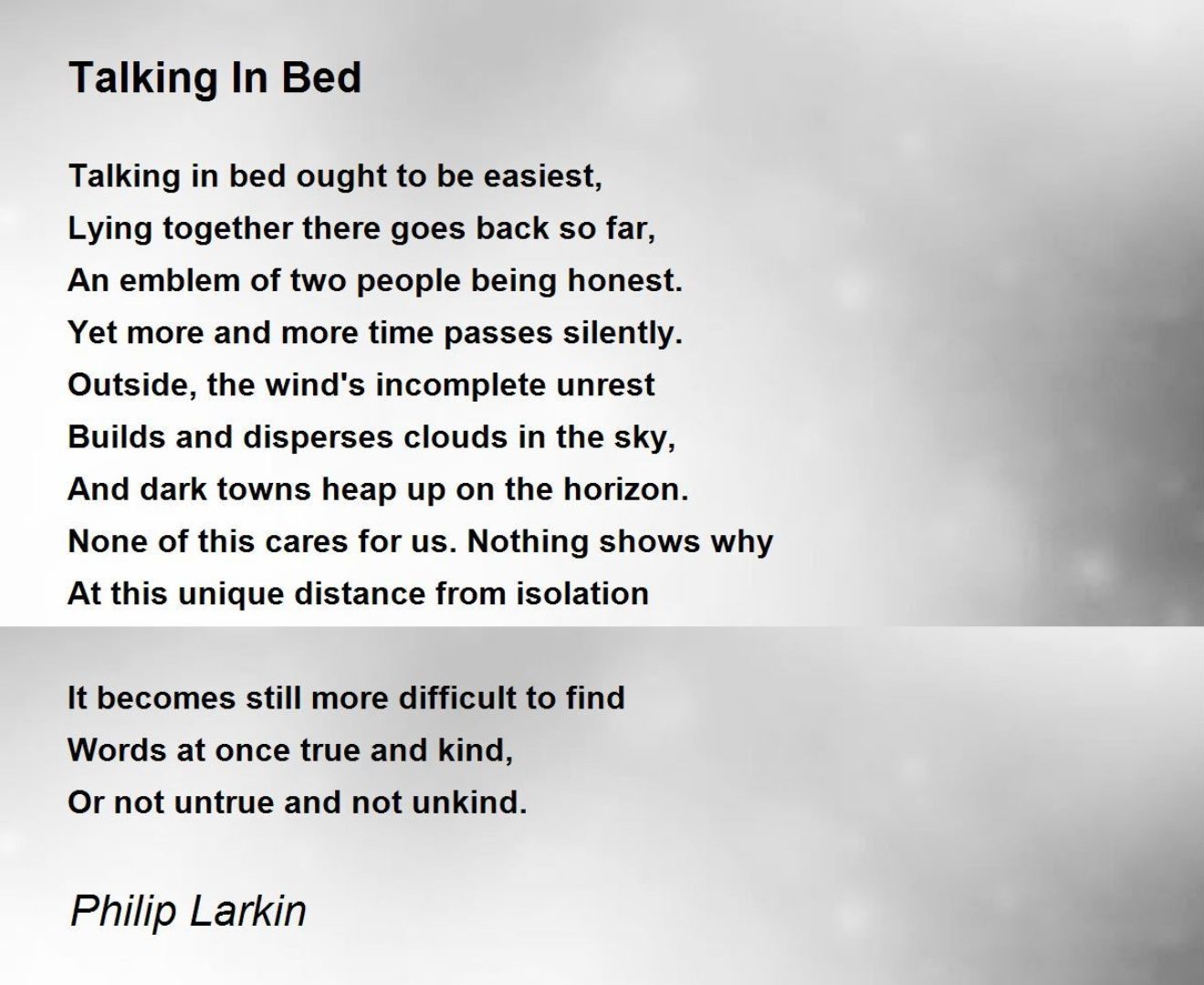
Featured Image Caption: Talking in Bed by Philip Larkin.
