
Written by: Ryan Krishna
Recently, I was asked what my favorite painting was. Within seconds, I knew my answer was Rembrandt’s Christ in the Storm on the Sea of Galilee, but I was curious why this was the case. I also started thinking about which paintings appeared in my head immediately after I answered, and whether those would also qualify as my “favorites.” I do not think I have a perfectly organized theory of what makes a painting my favorite, but the same few works keep coming back to me: Rembrandt’s Christ in the Storm on the Sea of Galilee, Monet’s Woman with a Parasol, Fragonard’s The Swing, and Van Gogh’s Green Wheat Fields, Auvers.

The Rembrandt is the easiest one for me to explain, at least at first. Within the painting, everything seems to be falling apart at the same time. The boat tilts violently as water crashes against its bow and side. A loose line whips through the stormy air, the sail bends under the force of the wind, and the crew all seem trapped in different stages of panic. Some are trying to keep the boat under control, some look completely overwhelmed, and Christ remains entirely calm in the middle of it all. This is what fascinates me. Despite Christ’s presence on the boat and his almost ethereal calmness, the fear of the boatmen is still everywhere; God himself is present, but the situation remains terrifying.

Monet’s Woman with a Parasol feels almost the opposite, and it is another of my all time favorites. There is no storm, no crisis, and no one trying to survive anything. It is a woman and a child standing outside in the wind. What I love most is how Monet makes the whole scene feel connected through color and movement. The green starts in the field at the bottom of the painting, then reappears slightly higher in the child’s hat. It seems to rise again through the center of the woman’s dress before returning once more in the shadowed underside of the parasol at the top. Monet adds motion with clouds that seem to blur into the lace of the woman’s headdress, both billowing in the wind of the field. The whole painting feels peaceful and idyllic, almost like Monet has captured a perfect slice of joy in the lives of these two figures.

Fragonard’s The Swing is one of those paintings that I like partly because it is so seemingly unserious. The woman swings through this overgrown garden in a huge pink dress, suspended between the man pushing her from the shadows and the admirer looking up from below. Her slipper flies off into the air, becoming its own little focal point within the painting. What I find most interesting is how the whole scene is arranged to make the woman stand out. The garden is lush and dark, while her dress is noticeably brighter, almost glowing against everything around it. She is caught in this perfect, impossible pose that makes the painting feel alive. The whole thing is theatrical in its excess of motion, color, and secrecy, and that is exactly why I like it.

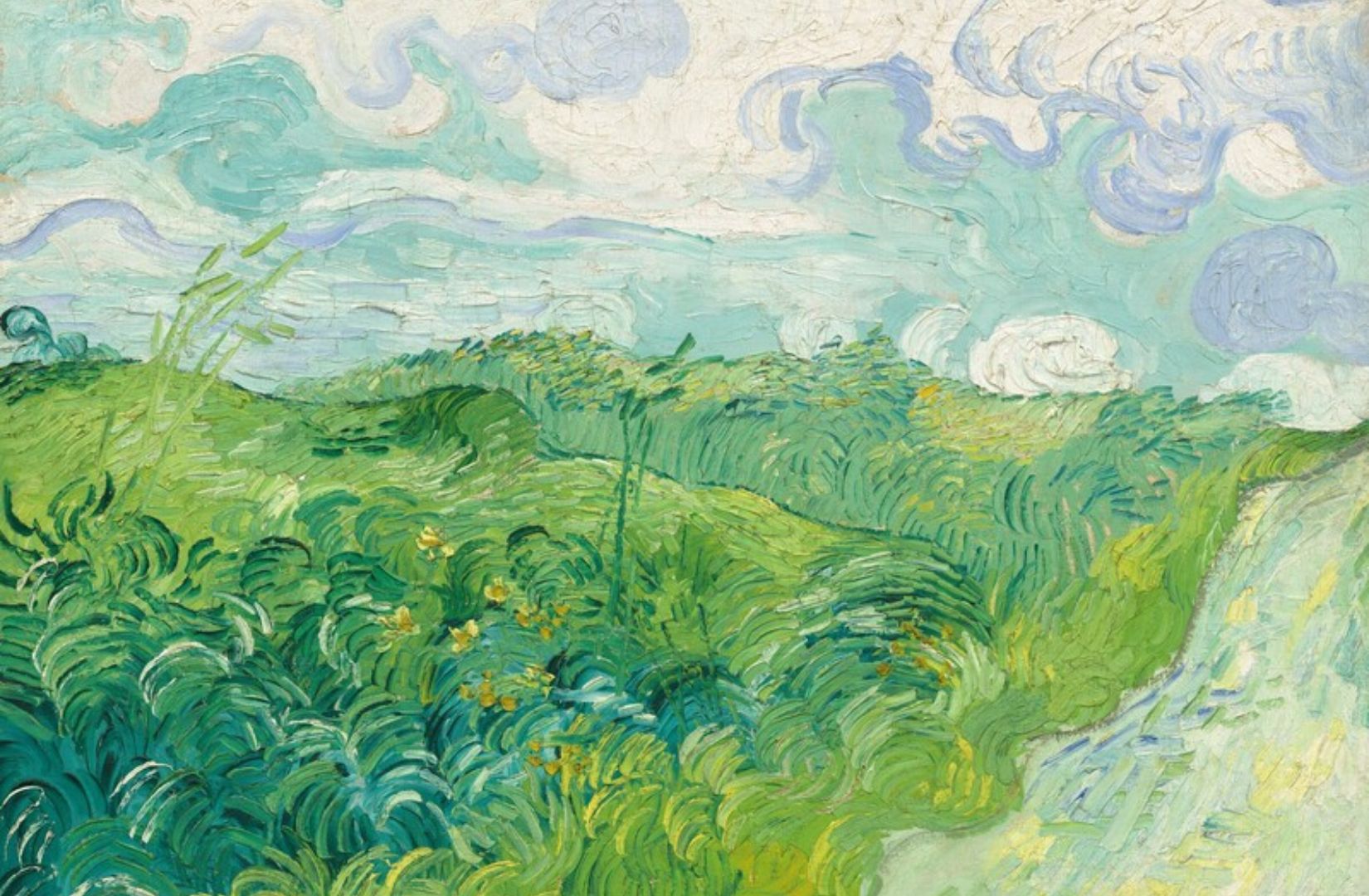
Van Gogh’s Green Wheat Fields, Auvers is noticeably quieter than the others, closer in feeling to Monet’s Woman with a Parasol, and it definitely belongs on my list of favorites. There are no people in it, and there is not really a scene unfolding in the normal sense. Still, the painting is far from empty. The field seems to ripple across the canvas, and the brushstrokes make the wheat feel like it is moving in the wind. The small yellow flowers near the front of the field also become a minimal focal point, giving the eye a place to pause within all of that movement. What I love is that Van Gogh gives the landscape this lively texture. The greens and yellows of the wheat, the pale road along the side, and the soft blue of the sky all make the painting feel peaceful, but not completely still. It has this quiet restlessness to it, resembling a calm moment only seconds before the wind moves through again.
Looking at these four paintings together, I think what draws me to them is how much life each one has. They are all beautiful in different ways, but they also feel active, whether through a storm, wind, a swing, or a field moving in the distance. I like when a painting feels alive enough that I want to keep looking at it, and these four are perfect examples of that.
Featured Image Caption: Van Gogh’s Green Wheat Fields, Auvers
Paintings Source Links:
https://www.gardnermuseum.org/experience/collection/10953
https://www.nga.gov/artworks/61379-woman-parasol-madame-monet-and-her-son
https://www.nga.gov/artworks/163323-green-wheat-fields-auvers

You must be logged in to post a comment.